 Spare Spoons Kitchen
Tiramisù
classico
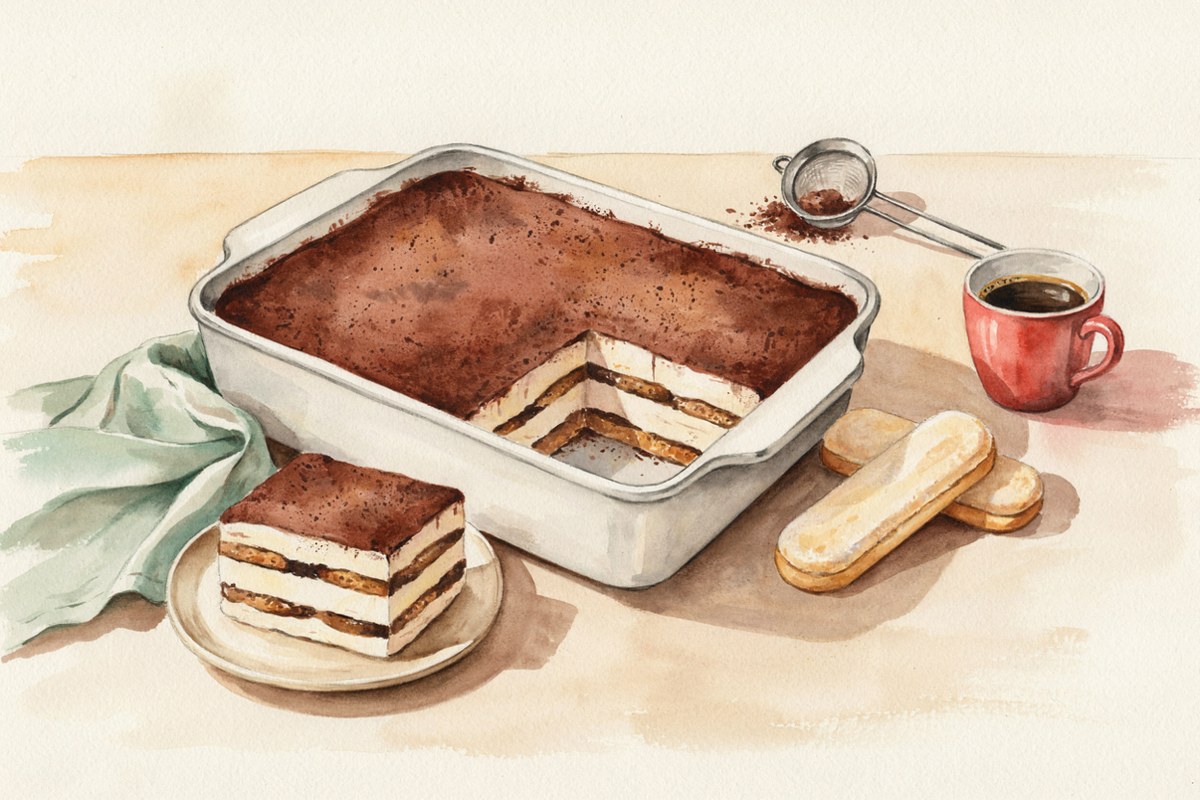
The Italian original: no cream anywhere, just whole eggs, mascarpone, coffee and cocoa. Whipped whites do the work the cream does in the other version, which makes it lighter and cleaner-tasting — the tiramisù you'd be served in Rome. Both the yolks and the whites go over a double boiler to 160°F, so it's fully food-safe despite never being baked, and ordinary supermarket eggs are fine. No oven, and it has to be made the day before, which is the best kind of dessert to owe a dinner party.

Ingredients
Before you start
Get these into the state the recipe asks for first — the steps that use them won't wait.
- A 9×13 dish, at least 2½ inches deep — two layers of savoiardi and the cream come to about 2¼ inches, so a standard 2-inch dish fills to the rim
- An instant-read thermometer, and a metal bowl that sits in your saucepan without touching the water — both bowls get taken to a specific temperature — this is the whole safety mechanism
- The coffee brewed and completely cold — warm coffee turns savoiardi to mush and slackens the cream
Method
Cook's notes
Why the sugar splits 90 and 90. Sugar isn't only sweetness here — it raises the temperature at which egg proteins coagulate, and that's the only thing letting you hold either bowl at 160°F without ending up with sweet scrambled eggs. Put it all in one bowl and the other one grains. Ninety grams across seven yolks also happens to land almost exactly on the classic zabaglione proportion of a tablespoon of sugar per yolk, which is a nice piece of confirmation that the split isn't arbitrary.
Ninety grams is lean for that many whites. A textbook Swiss meringue runs closer to twice the weight of sugar to whites; this is well under. It works, but it means less protection, so keep the water at a bare tremble rather than a simmer, never stop whisking, and don't let the bowl sit still on the heat. If it starts to look grainy at the edge, pull it off, whisk hard for fifteen seconds, and put it back.
This is the version without cream, and it eats differently. The other tiramisù folds whipped cream into a cooked zabaglione: richer, firmer, and it keeps two to three days. This one has no cream at all — the whites supply the lift and the mascarpone supplies all the fat. It's lighter and the coffee comes through more clearly, but it also sets softer and it weeps. Eat it within a day. That's not a flaw to engineer around; it's what the original is.
Why it's one size. The pan is fixed at a 9×13 and the eggs are whole, so there's no honest way to scale by thirds — you'd be working out what four and two-thirds eggs means. The Giallo Zafferano original is built for a 35×25 cm (14×10 inch) dish with 8 eggs and a full kilo of mascarpone; these numbers are that recipe brought down about ten percent, which lands almost exactly on a standard American 9×13 and on 2 lb of mascarpone, which is four 8-oz tubs. Convenient rather than clever.
Pan depth matters more than you'd guess. Two layers of savoiardi run about an inch and a quarter stacked, and the cream adds another inch — call it 2¼ inches of dessert. A standard 9×13 Pyrex is exactly 2 inches deep, so it fits but fills to the rim, which is why the toothpicks are in the method. A dish 2½ to 3 inches deep, usually sold as a lasagna pan, gives you room to cover it properly.
You don't need pasteurized eggs for this. That's the whole point of taking both bowls to 160°F — the recipe pasteurizes them itself, so ordinary eggs from any carton are fine. If you'd rather skip both double boilers entirely, pasteurized in-shell eggs (Davidson's Safest Choice is the common one) let you whip everything cold and unheated the way Giallo Zafferano actually writes it. You can also pasteurize your own in a sous vide bath at 135°F for 75 minutes, then an ice bath.
A second per side, and no more. Savoiardi are dry and thirsty and they keep absorbing after you've set them down. A quick in-and-out looks far too brief and is correct; leave them in until they feel soft in your fingers and the bottom layer will be soup by morning.
Mascarpone has to be at room temperature. Cold mascarpone seizes into lumps the moment it meets the yolk base and no amount of beating smooths it out — and beating is exactly what splits it. Take it out an hour ahead. If it does go grainy, a few seconds with a stick blender sometimes rescues it, but prevention is the only reliable route.
Marsala is my addition, not the original's. Giallo Zafferano's version has no alcohol at all. Seven yolks and 90 g of sugar make a stiff paste that heats unevenly and can set at the edge of the bowl before the middle catches up, and a little liquid solves that. Water does the job identically if you'd rather leave it out; the Marsala is there because it also tastes of something.
Coffee quantity. You'll only get 180 ml or so into the savoiardi, but you need a bowl deep enough to dip in, so brew the full 400 ml and pour the rest away. Trying to dip in a shallow puddle means uneven soaking, and uneven soaking is the difference between this and a good version of this.
Easier, if you like
- Buy pasteurized eggs and skip both double boilers. With pasteurized in-shell eggs you can whip the yolks and whites cold and unheated, exactly as the Italian original is written — it turns a 45-minute recipe into about 20.
- It has to be made the day before anyway, so this is the rare dessert where doing it in advance isn't organisation, it's the recipe. Make it whenever you have the energy; it just sits.
- Instant espresso powder dissolved in hot water and cooled works perfectly well here and saves pulling shots. The coffee is a soaking liquid, not a tasting flight.
- A stand mixer does the whites while you do the mascarpone, which is the only real time saving available. If you've only got a hand mixer, do the whites last and have everything else ready.
Vegetarian · easily alcohol-free
Alcohol-free: swap the Marsala for plain water — it's there for texture, not flavour, and the recipe it comes from doesn't use any.
Gluten-free: the only gluten is in the savoiardi. Gluten-free ladyfingers exist and behave much the same, though they tend to be a little more fragile, so dip them even more briefly.
No Marsala in the house? Dark rum, brandy, or a coffee liqueur all work in the same quantity, or stir a tablespoon into the coffee instead and leave the yolks with water.
Decaf makes a perfectly good tiramisù and is worth considering given it's a dessert people eat late.