 Spare Spoons Kitchen
Tuscan
Meat Sauce
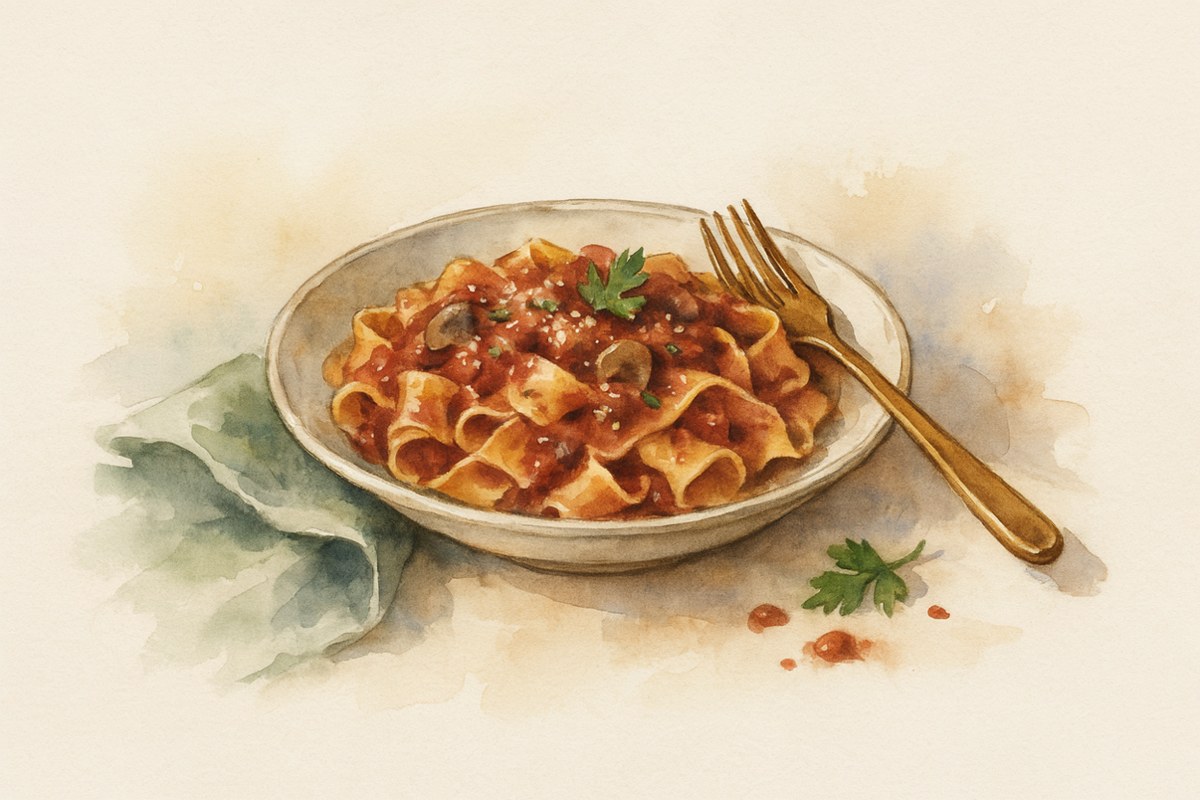
Giuliano Bugialli's Tuscan ragù — a slow-cooked soffritto, dried porcini, a whisper of lemon peel, and a lazy hour-and-a-half simmer fed with broth. Deep, woodsy, and unmistakably Tuscan.

Ingredients
Method
Cook's notes
The authentic cut: snip, don't grind. Bugialli's ragù uses beef sirloin snipped into tiny pieces with scissors rather than ground, so the bits keep their "identity and flavor" (his words) instead of melting into one uniform texture. Take a ½-lb piece of sirloin, half-freeze it so it cuts cleanly, and snip it into rice- to pea-sized pieces. Ground beef — what most of us reach for — makes a lovely sauce; the snipped version makes a more interesting one.
Mind the grit. Dried porcini shed sand as they soak. Lift the mushrooms out rather than pouring, and when you add the soaking liquid, leave the last cloudy spoonful in the bowl. To catch even that, strain it — a coffee filter or paper towel is the handiest, and a doubled layer of cheesecloth works well too.
Terra-cotta if you have it, any heavy pot if you don't. Bugialli calls for a flameproof terra-cotta casserole, which holds a gentle, even heat — but a Dutch oven or any heavy-bottomed pot does the job. What matters is low heat and time.
Use beef with some fat. An 80–85% grind, or sirloin with its marbling. Very lean meat makes a tighter, harsher sauce; a little fat is what keeps a ragù silky.
It only improves. The sauce keeps 3 days refrigerated and freezes beautifully — the flavor deepens overnight, so it's a fine make-ahead for a Sunday.
Provenance: adapted from Giuliano Bugialli's Tuscan meat sauce in The Fine Art of Italian Cooking — the book that taught a generation of American cooks how Italians really cook. (That book link is an affiliate link — as an Amazon Associate we earn from qualifying purchases, at no extra cost to you.)
Easier, if you like
- Make a double batch and freeze. The long simmer is the same work for twice the sauce — double everything (a 28-oz can of tomatoes lands right at 2×) and freeze half.
- No porcini? A handful of fresh cremini, finely chopped and softened with the soffritto, plus an extra teaspoon of tomato paste for depth, stands in — you lose the woodsy note but keep the body.
- Toss it with fresh pappardelle for the full Tuscan Sunday — wide ribbons are the classic partner for a sauce this rich.
It's already gluten-free (the sauce)
Gluten-free: the ragù has no flour — serve it over gluten-free pasta, soft polenta, or a mound of mashed potato.
Dairy-free: it's dairy-free until the cheese — just skip the parmigiano, or use a hard vegan cheese.