 Spare Spoons Kitchen
Microwave Mug
Mac & Cheese
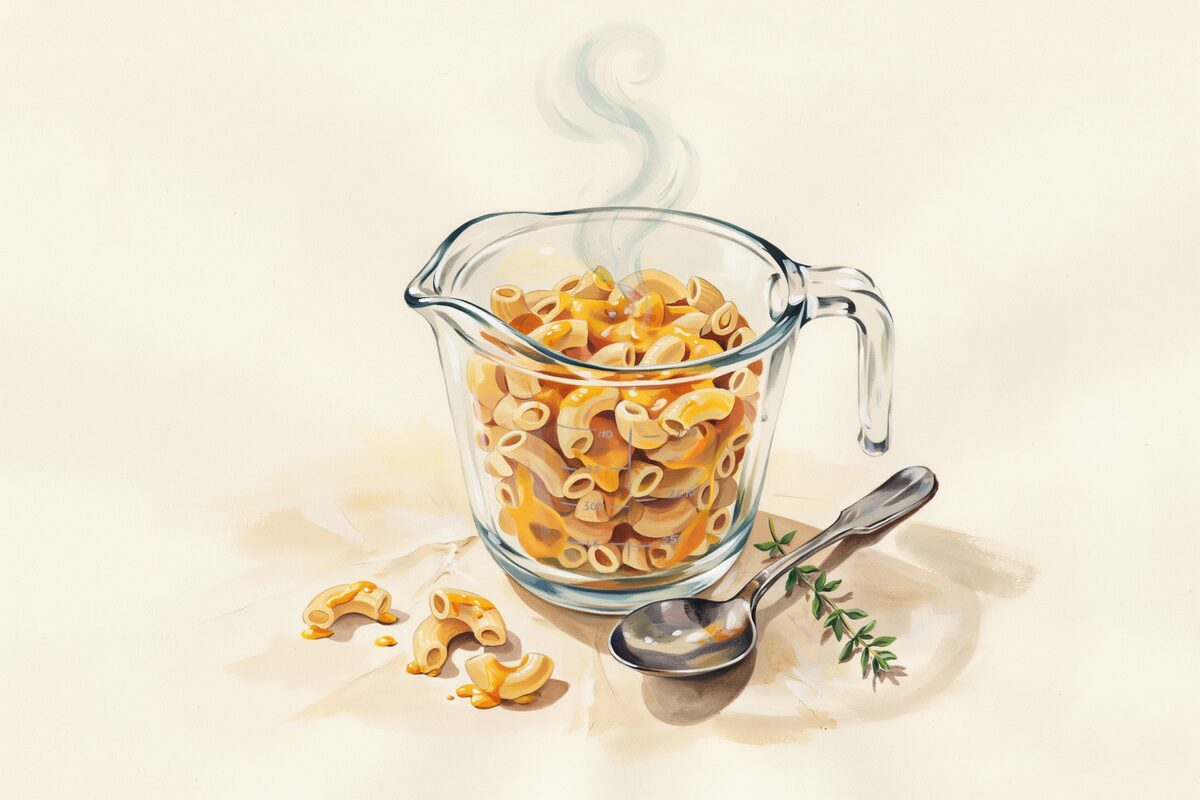
A real, hot bowl of mac and cheese in about five minutes, in a single mug, with nothing but a microwave — for the nights when the stove is too much but you still want something warm. Exact amounts so it comes out creamy, not gluey.

Ingredients
Method
Cook's notes
No stove, no pot, one mug. This is here for the nights when cooking isn't going to happen but you still want something warm — beige comfort food, no shame.
Make it heartier: stir in a handful of frozen peas or spinach with the pasta, or a few spoonfuls of canned chicken or white beans at the end — protein and veg with almost no extra effort. (Half the pantry shelf works here.)
Cheese decides the texture. American slices and Velveeta have emulsifiers that melt into a thick, silky sauce that isn't stringy — the most foolproof choice. Real cheddar (a block, or slices like Tillamook Farmstyle) tastes best but melts looser and a little stringy, and doesn't thicken on its own. Using real cheddar? Keep the milk low, microwave a few extra seconds so the sauce reduces and clings, and — for a guaranteed thick, un-stringy result — toss the shredded cheddar with ½ tsp cornstarch before it goes in; the starch thickens the sauce and stops the cheese from turning ropey.
The smoothest sauce of all: swap the milk for a splash of evaporated milk — it's more stable and won't break, so the cheese melts glossy every time. A small can keeps in the pantry for exactly this.
Boil-over insurance: the bigger the mug, the better — and stirring breaks the foam. If yours runs hot, cook in shorter bursts.
Best vessel — a 2-cup glass measuring cup. A Pyrex (or similar) 2-cup measure beats a mug: the glass shrugs off the heat, the 2-cup size leaves headroom for the foam, and — best of all — the handle stays cool, so you can lift it straight out of the microwave without burning your hand. Doubling it for two? Step up to a 4-cup measure for the same headroom — a glass measuring-cup set covers both sizes.
Cooking a double batch? Two servings is twice the water to heat, so it takes noticeably longer in the microwave — more like 6–8 minutes — and foams up more. Stir more often, lean on the 4-cup measure's extra headroom, and go by the pasta: it's done when tender and the sauce is creamy, whatever the clock says.
Microwaves vary a lot in power, so the times here are a starting point; the real cues are tender pasta and a glossy, creamy sauce.
Easier, if you like
- The zero-decision version: a single-serve microwave mac cup (like Kraft Easy Mac) — just add water and microwave. This from-scratch mug is barely more effort and tastes better, but on the hardest days the cup is a win, not a cheat.
Vegetarian; easy to make gluten-free or vegan
Gluten-free: use a gluten-free small pasta — it microwaves the same way; check it a little early, as GF pasta softens fast.
Vegan / dairy-free: use a plant milk and a vegan cheese (or about 2 tbsp nutritional yeast plus a little extra plant milk and a dab of vegan butter). Our cashew cheese sauce stirred in works beautifully too.