 Spare Spoons Kitchen
Hamburger
Patties
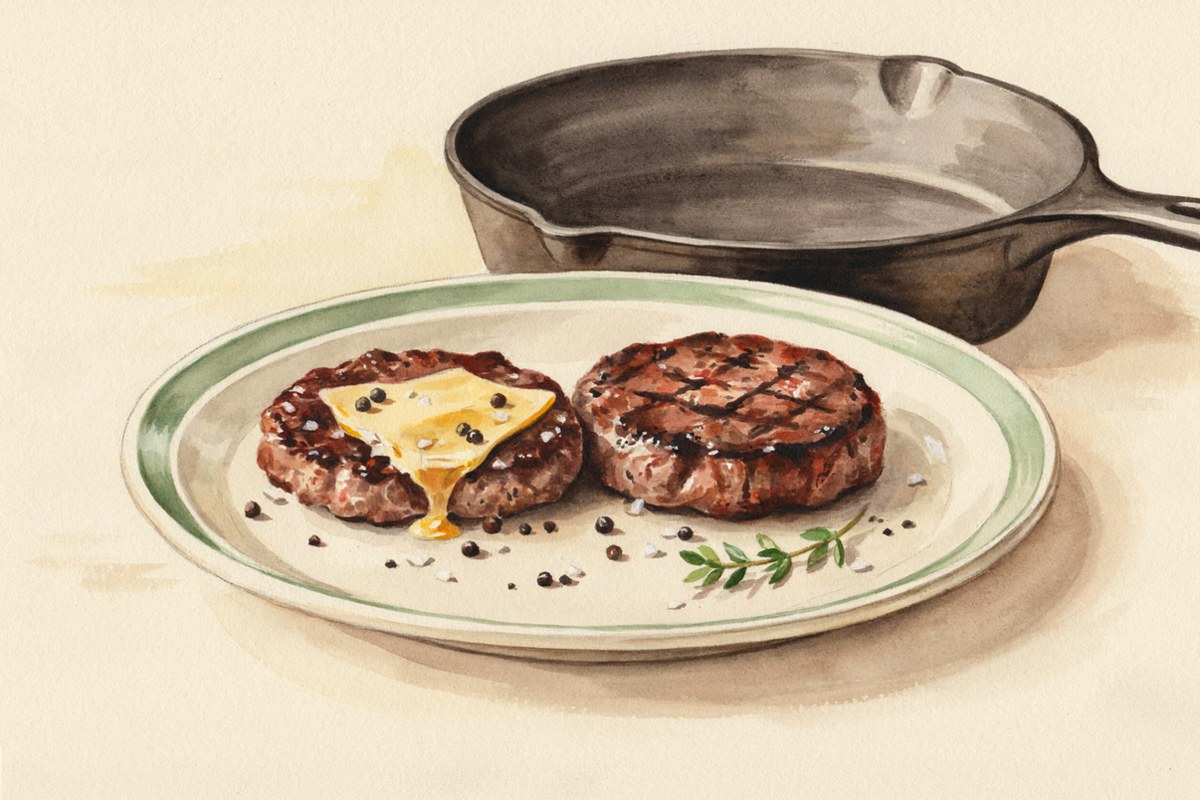
A proper burger patty is mostly restraint: good 80/20 chuck, handled as little as possible, salted only on the outside and only at the last moment. Two ways to cook it — smashed thin on screaming-hot cast iron for maximum crust, or a thick pub-style patty on the grill. Same meat, same rules, different burger. Best on homemade buns.

Ingredients
Method
Cook's notes
Doneness, honestly. The USDA recommends ground beef be cooked to 160°F (71°C), and the reasoning is sound: grinding takes bacteria that lived on the surface of the cut and distributes them all the way through, so unlike a steak you can't rely on searing the outside. Plenty of people cook thick burgers to medium and enjoy them, and I'm not going to pretend otherwise — but it is a real risk rather than a theoretical one, and it isn't one worth taking for young children, older adults, anyone pregnant, or anyone immune-compromised. If you want a pink burger with the risk substantially reduced, grind your own from a whole chuck roast you've seared the exterior of first, or buy from a butcher who grinds in-house that morning. Smash patties sidestep the question entirely: at a quarter-inch thick they pass 160°F in the time it takes to build the crust.
80/20 is the number, and it isn't negotiable. Twenty percent fat is what makes a burger juicy, carries the flavour, and gives you the fat that renders out and fries the crust. Ninety-ten mince makes a dry, crumbly patty no technique can rescue. Chuck is the classic cut for exactly this ratio; brisket or short rib blends are richer still if your butcher grinds them.
Why the salt rule matters so much. Salt dissolves myosin, a protein in muscle that then binds the meat strands together — it's precisely how sausage and meatballs get their bouncy, cohesive texture, and precisely what you don't want in a burger. Mix salt through the meat and you'll get a patty that's springy and tight. Salt only the surface, moments before it cooks, and the interior stays loose and tender.
Don't press the patty. That satisfying sizzle when someone squashes a burger with a spatula is the sound of the juice leaving. The only legitimate press is the single hard smash at the start of the smash method, done while the meat is still raw and before any juice has been rendered.
The dimple. Meat contracts as it cooks, and a thick patty contracts most around its edge, which pushes the middle up into a dome. A shallow thumbprint in the centre gives it somewhere to expand into, so you finish with a flat patty that sits properly in a bun rather than a meatball.
Cheese. American melts better than anything else because of the emulsifying salts in it — that's the whole reason burger joints use it, not laziness. If you'd rather have real cheese, thin slices of a young cheddar, Swiss, or provolone melt best, and covering the pan with a lid for the last thirty seconds traps enough steam to do the job. A teaspoon of water flicked into the pan under the lid melts cheese almost instantly.
Toast the buns. Split them and toast the cut faces in the pan fat or on the grill for thirty seconds until golden. It takes almost no time and it's what stops the bottom bun going soggy — worth doing even on a weeknight. The homemade buns take particularly well to it.
Make-ahead. Shape the patties, stack them with squares of parchment between, and refrigerate up to a day or freeze up to three months. Cook thick patties from frozen if you like — add about 50% to the time. Smash balls are best shaped fresh, but they take two minutes to portion.
Cold meat, hot pan. Cold beef holds its shape while the surface browns, which is what gives you crust rather than grey steam. Take the patties from the fridge straight to the heat; there's nothing to gain from letting them come to room temperature here.
Easier, if you like
- Smash is the fast one. Start to finish it's under ten minutes, needs no thermometer, and cooks two burgers at a time in one pan — the better choice on a low-energy night.
- Portion and freeze a big batch. Do the shaping once with parchment between the patties, and future dinners become 'take four out of the freezer.'
- Skip the cheese step entirely — a good patty on a toasted bun with nothing but salt is a genuinely fine burger, and it's one less thing.
- A splash of water and a lid melts cheese in seconds, so you don't have to overcook the patty waiting for it.
Gluten-free as written
Gluten-free: the patty itself has no binder and no breadcrumb — it's just beef and seasoning — so it's naturally gluten-free. The bun is the only thing to swap.
Dairy-free: leave the cheese off, or use a plant-based slice.
Ground turkey or chicken can't follow this recipe directly: they're much leaner and must reach 165°F, so they need a binder and a gentler hand. Treat that as a different recipe rather than a substitution.
Bison works well but is very lean — cook it a touch less and expect a firmer patty.